Learn how the habit works
Cues, routines and rewards explained in plain language, along with an honest summary of what research does and does not show.


A practical, non-judgmental guide to understanding unwanted pornography-use habits, mapping your triggers, rebuilding your surroundings and routines, and following a structured 30-day plan.
Educational self-help for adults. The Reset Path is not medical or mental health care and does not promise a particular outcome.
An introduction, 12 chapters, worksheets and checklists, the RESET Protocol, a 30-day plan with daily tracker, a long-term maintenance plan, a one-page quick reference, a Safety & Support page and a list of cited sources.
The guide combines the author's personal story, clearly labelled as experience, with practical habit-change methods and a plain-language summary of what research does and does not show.
About the guide
“The struggle often begins long before you open the browser.”

The Reset Path is a practical guide for adults who want to understand and change unwanted pornography-use habits. It treats the pattern as something learned, not as a character flaw, and it avoids shame-based language and exaggerated claims.
Understand. Why the habit holds on, what research does and does not show, what common physical worries mean, and how to map your own triggers.
Change. Your surroundings, your devices, the RESET Protocol for urges, routines that do not depend on motivation, how to recover from a slip, and how to reconnect with people.
Commit. A structured 30-day plan, and a lighter long-term plan for the months after.
The guide opens with the author's own experience. Physical and emotional observations are described as personal observations, not as established medical explanations, and the guide points you to a doctor for physical concerns.
The guide separates habits you want to change, conflicts with your values, and clinically significant compulsive sexual behaviour. It does not say that everyone who watches pornography is addicted, or that masturbation is inherently harmful, and it makes no promise about outcomes or timelines.
What you can do with it
The guide is designed to support reflection, habit awareness, digital boundaries and structured personal change. It does not promise a particular outcome or timeline.
Cues, routines and rewards explained in plain language, along with an honest summary of what research does and does not show.
Use the seven-day trigger log and the five-stage cycle to see when, where and why urges tend to begin.
Rearrange your room, your phone and your unplanned hours, and choose a few tools to add friction, with privacy cautions.
Write if-then plans and an urge-response card in advance, then use the RESET Protocol when the moment comes.
A four-step recovery process and a setback review that separate responsibility from self-punishment.
Detailed contents
The guide moves from understanding your pattern, to changing it, to committing to a plan that lasts.
Why the pattern formed, how it works, and where yours begins.
Practical changes to your surroundings, devices, urges, routine and relationships.
Thirty days of practice, and a plan that lasts beyond them.
Also included: an introduction, a Safety & Support page, a one-page quick reference, and a list of the sources cited.
The method
Decide in advance what you will do, so you are not inventing a plan while an urge is at its strongest. You can repeat the sequence as many times as you need.
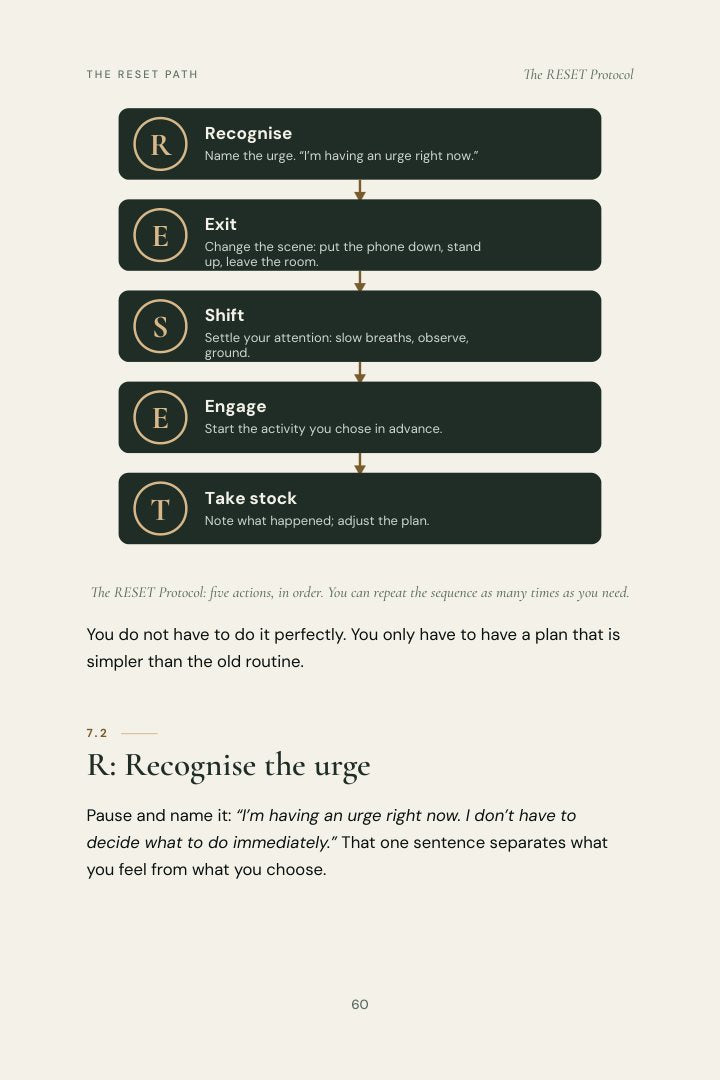
Name the urge without arguing with it: "I'm having an urge right now." You can notice a feeling without obeying it.
Change the scene. Put the phone down, stand up or leave the room, so the next thirty seconds look different.
Settle your attention with slow breathing, observing the urge or grounding, instead of fighting your thoughts.
Start an activity you chose in advance. Decisions made while calm are easier to follow.
Note what happened and what helped, then adjust the plan without judging yourself.
Preview
Select a page to enlarge it.
These images show pages from the ebook. Layout details may change between editions.
Included resources
Every chapter ends with an action, and most include a worksheet you can complete in a notebook or notes app.
Record when, where and why urges begin, then choose two or three changes that match what you actually found.
Fill it in while you are calm: your usual trigger, your first move, a grounding technique and one person to contact.
Concrete changes to your room, phone and unplanned hours that make the better choice easier.
Four weeks of daily tasks, each taking about fifteen to thirty minutes, with a checkpoint at the end of every week.
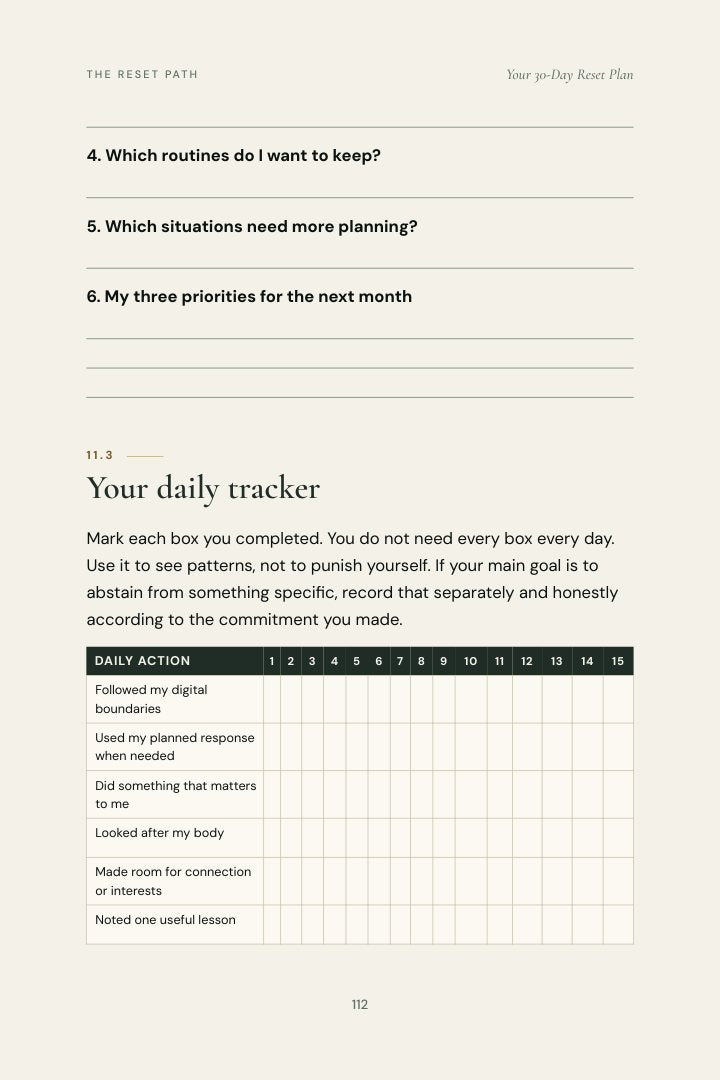
A simple 30-day grid for six daily actions, designed to show patterns rather than to judge you.
A ten-minute review for the day you slip: what happened, what was hard, and one adjustment.
Your early warning signs, higher-risk situations and support ladder, with weekly, monthly and quarterly reviews.
Small, practical steps to rebuild conversation, friendships and shared activities.
Who it is for
The Reset Path is a self-guided educational resource. It is for people who want practical steps, not lectures.
An educational guide, not treatment. The Reset Path does not diagnose or treat any condition, and it does not promise a particular outcome or timeline. It is written for adults aged 18 and over.
Reader feedback
I’ve been looking for a practical way to understand my habits and make changes without constantly feeling guilty about them. What I liked about The Reset Path is that it focuses on understanding triggers and building better routines instead of simply telling you to use more willpower. The RESET Protocol gave me a straightforward process to think through, and I liked having exercises and a 30 day plan to follow. It feels like something I can revisit when I need direction rather than just read once and forget. A helpful resource for anyone who wants to approach habit change more intentionally.
I liked this one more than I expected. It doesn't just tell you to stop and have more self-control. It actually gives you practical things to work on and a plan to follow. The tone is easygoing and not judgmental, which I really appreciated. Definitely worth checking out if you're trying to make a change.
I liked how simple and practical this guide is. It helped me understand my habits better and gave me some useful things to work on. Definitely worth reading if you're trying to make a change
Questions
If your question is not here, use the Contact link in the footer.
A digital ebook: a practical, non-judgmental guide for adults who want to change unwanted pornography-use habits. It has 12 chapters in three parts, worksheets, the RESET Protocol, a 30-day plan and a long-term maintenance plan.
No. The guide separates a habit you want to change, a conflict with your personal values, and clinically significant compulsive sexual behaviour. It does not treat masturbation as inherently harmful, and it recommends professional support where it may be needed.
It is a practical self-help guide that draws on published research where it exists and lists the sources it cites. It also shares the author's personal experience, which is labelled as experience rather than evidence. It does not claim to "rewire" your brain or to guarantee any outcome.
No. The Reset Path is educational self-help. It does not diagnose or treat any condition. If your distress is persistent, or your behaviour keeps interfering with your life despite real effort, please speak with a qualified professional.
Adults aged 18 and over. If you are younger than 18, please talk with a parent, carer, school counsellor or doctor instead.
No. It is a digital ebook, so nothing is shipped.
Once your order is placed, your order confirmation explains how to access your copy.
No guide can promise that. People change at different speeds, and some need professional support alongside self-help. The Reset Path gives you a structured way to understand your pattern, test practical changes and keep what works.

Ready when you are
Get the guide, complete the starting-point exercise in Chapter 1, and decide what you will do with your next unplanned hour.
Rs. 399.00Digital ebook
Educational self-help for adults. Not medical or mental health treatment.